

A client comes in three months into a GLP-1 prescription. The scale is moving, her blood work is better, and she is happy. Then she says the sentence we hear more and more: “My body looks younger and my face looks older.” Friends ask if she is tired. Her cheeks look flatter in photos, and the lines beside her mouth seem deeper than they did last spring.
That experience now has a nickname, “Ozempic face,” and it is common enough that plastic surgery and dermatology journals have started reviewing it formally. This article walks through what is known, which parts of the face tend to change, what an experienced injector actually evaluates, and how the main options compare. It is written for people deciding whether to do anything at all, not to sell a treatment.
Why this is suddenly a common question
GLP-1 medicines went from a diabetes niche to a mainstream weight-loss tool in a few years. A 2025 systematic review in Aesthetic Surgery Journal Open Forum cites an estimate that about 13% of U.S. adults, roughly 32 million people, have used a GLP-1 receptor agonist at some point. The amount of weight involved is also larger than with older approaches. When the FDA approved tirzepatide for chronic weight management in November 2023, it reported that adults without diabetes on the highest dose lost an average of 18% of body weight compared with placebo over 72 weeks.
Faces carry a lot of fat compared with how small they are. Lose a fifth of your body weight in a year and the face rarely stays the same.
Which parts of the face change first
The same review lists the areas that most often look different after GLP-1-driven weight loss: the temples, cheeks, tear trough, jawline, marionette lines and nasolabial folds. Fat loss there can make people “appear gaunt and resemble advanced facial aging,” in the authors’ words.
A 2025 review of eye-area changes in the Journal of Clinical Medicine adds two useful numbers from earlier work:
- An imaging study found patients lost about 11% of superficial midface volume against 7% of deep midface volume, and estimated roughly 7% of midface volume lost for every 10 kg of body weight.
- In one survey, 65% of GLP-1 patients said they noticed facial volume loss, more so in older patients and in those who lost more than 10% of body weight within six months.
| Area | What people usually notice |
|---|---|
| Temples | A “pinched” upper face, the brow tail looks lower |
| Cheeks and midface | Flatter cheeks in profile, less light catching the cheekbone |
| Tear trough | Hollow, shadowed under-eyes even after sleep |
| Nasolabial folds and marionette lines | Deeper creases beside the nose and mouth |
| Jawline | Softer jaw edge, early jowling |
Is it the drug, or just the weight loss?
This is still debated, and an honest consultation says so.
- A 2025 review in Diseases that screened the dermatology literature on GLP-1 medicines describes the facial changes as mimicking typical aging but appearing suddenly in people who are still relatively young. The authors lean toward rapid systemic fat loss as the main driver rather than a direct effect on facial fat cells.
- A 2025 paper in Endocrine lays out a competing possibility: laboratory work suggests these medicines act on stem cells in fat tissue and may affect collagen-supporting signals in the skin, while also lowering inflammation. The authors conclude it remains unclear whether skin aging speeds up while the rest of the body benefits.
- The Aesthetic Surgery Journal Open Forum review frames it a third way: the medicines may mainly “emphasize the age-related gradual decrease in elastin turnover” by leaving looser skin over a thinner layer of fat.
For a patient the practical meaning is the same. Rate and amount of weight loss, age and skin quality matter more than the brand name on the pen.
What a good injector evaluates before suggesting anything
A consultation for post-weight-loss volume change is not “where do you want filler?” These are the questions that change the plan:
- Is your weight still moving? Treating a face that will lose another 10 kg means retreating it later. Many injectors prefer to wait until weight has been stable for a few months, or to start conservatively.
- Volume or laxity? Lost volume responds to fillers or biostimulators. Loose skin over a reasonable amount of volume does not, and adding product to it can look heavy rather than younger.
- Skin quality. Thin, dry or crepey skin changes which products and depths make sense. The Aesthetic Surgery Journal Open Forum review also notes that rapid nutrient loss during dieting can weaken the skin barrier.
- Your goals and budget over time. Some options are one visit; some are a series spread over months.
- Medical history. Allergies (including to lidocaine), prior filler, autoimmune conditions and medications all matter.
The eye-area review makes a point worth repeating: only 38% of the studies it looked at reported consistently counseling patients about aesthetic effects before treatment. If nobody discussed this with you when the prescription started, that is common, not your fault.

The main options, side by side
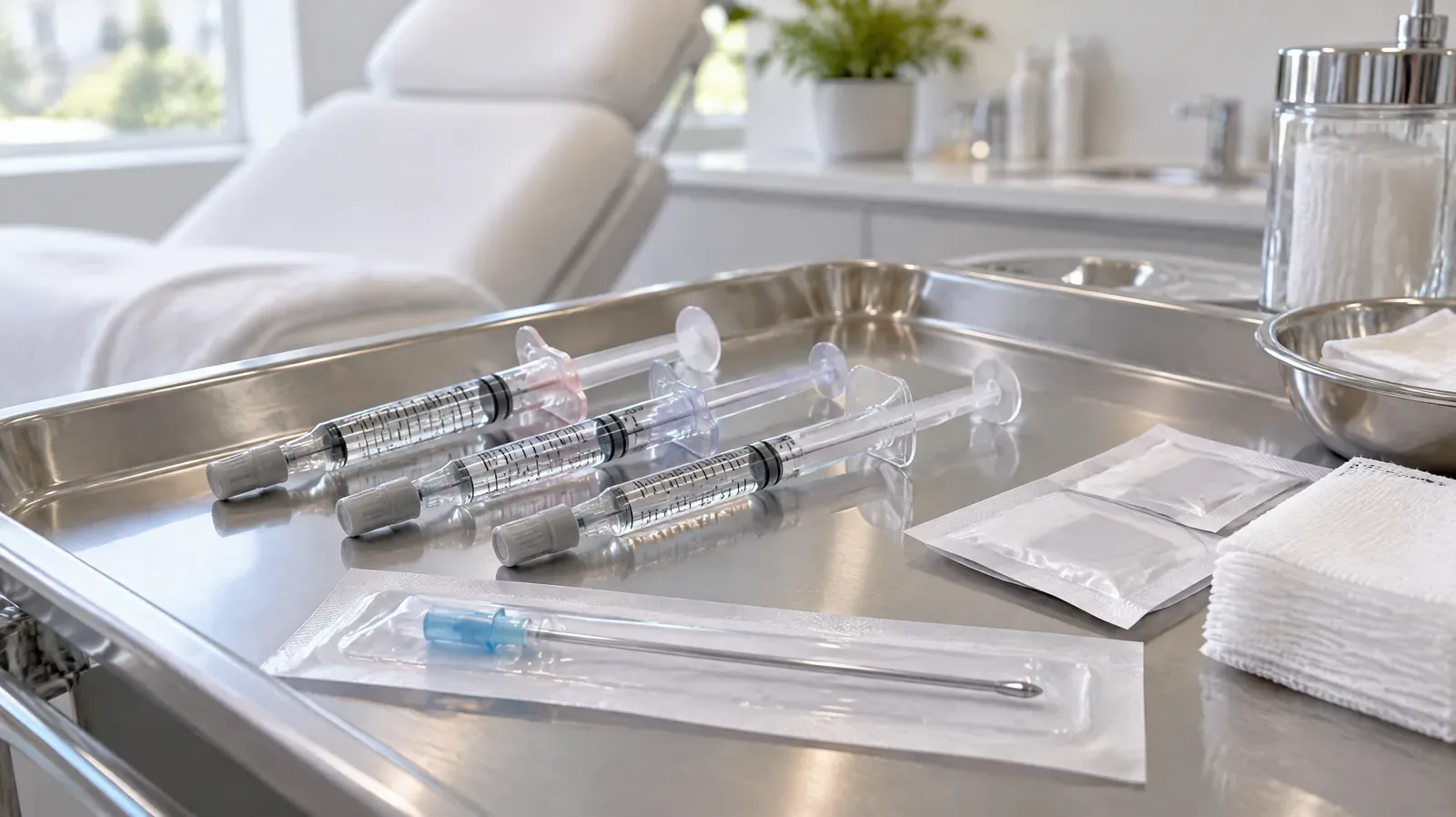
The American Academy of Dermatology lists FDA-approved filler types that include hyaluronic acid gel, calcium hydroxylapatite, poly-L-lactic acid and PMMA. Its filler FAQ gives typical durations:
| Option | How it works | Typical duration (AAD) | Notes |
|---|---|---|---|
| Hyaluronic acid filler | Gel that adds volume where it is placed | 4 to 12 months | Can be dissolved if needed, which many injectors value for first treatments |
| Calcium hydroxylapatite | Gel with particles that support structure | 6 months to 1 year | Often used for deeper support along cheek and jaw |
| Poly-L-lactic acid | Biostimulator that prompts your own collagen over time | 1 to 3 years | Results build gradually over a series of visits |
| PMMA | Microspheres in a collagen gel | Permanent | Not removable; FDA approval is limited to specific areas |
On this site you can read more about dermal fillers and Bellafill, which is a PMMA product.
Beyond fillers, the review literature describes:
- Skin-quality treatments such as radiofrequency microneedling and laser resurfacing, which target texture and firmness rather than volume. The AAD notes that laser resurfacing gives the fastest visible tightening but needs about 5 to 7 days of downtime, while minimally invasive radiofrequency results usually appear in about a month.
- Thread lifts for mild sagging, discussed on our PDO thread lift page.
- Surgery, including facelift, neck lift and fat grafting, for laxity that injectables cannot honestly fix.
Safety points that are not negotiable
The FDA’s page on dermal fillers is short and worth reading in full. A few points stand out for anyone treating volume loss:
- Fillers are medical devices. The FDA approves them for specific areas such as the cheeks, lips, chin, nasolabial folds and the backs of the hands, and for adults 22 and older.
- The most serious risk is accidental injection into a blood vessel, which the FDA warns can cause tissue death, vision problems including blindness, and stroke. Anatomy knowledge and technique are the protection.
- Permanent fillers, and fillers not made of hyaluronic acid, may be difficult or impossible to remove.
- The FDA has not approved any filler for over-the-counter use, and it has not approved needle-free devices for injecting fillers.
The AAD adds that common short-term effects such as redness, swelling, tenderness and occasional bruising usually settle within 7 to 14 days, and that more serious problems are more likely when the injector lacks adequate medical training.
A sensible order of operations
For most people we would suggest thinking in this order:
- Talk with your prescriber about the pace of weight loss. Faster is not always better for your face.
- Protect skin quality while losing weight: adequate protein, daily sunscreen and a simple, non-irritating routine. Our piece on what medical-grade skincare actually means covers how to choose products without paying for labels.
- Once weight is stable, book a consultation focused on volume versus laxity, not on a specific product.
- If you start with filler, start conservatively and with a reversible product where that suits the area. A second visit is easier than undoing too much.
- Reassess in three to six months, and again if your weight changes meaningfully.

Three myths we hear every week
“Filler will make me look like I did before.” Filler replaces volume in specific places. It does not tighten skin that has stretched and lost support, and trying to fill a lax face back to its old shape is how people end up looking puffy rather than rested. Good results usually look like a well-rested version of your current face.
“If I stop the medicine, my face will come back.” If weight returns, some facial fullness usually does too, but not necessarily in the same places or with the same skin quality. Stopping a medicine for cosmetic reasons is a decision for you and your prescriber, not for an injector.
“More product now saves money later.” With temporary fillers, the AAD’s own ranges mean you are paying for months, not years. Large first-visit volumes also make it harder to judge what your face actually needed. Small, staged treatments usually cost less over a year because less ends up redone.
How long results last, and what maintenance looks like
Planning is easier when you think in a 12- to 24-month window rather than a single appointment:
- Hyaluronic acid: the AAD gives 4 to 12 months. Areas that move a lot, such as around the mouth, tend to sit at the shorter end; deeper cheek support often lasts longer.
- Poly-L-lactic acid: the AAD gives 1 to 3 years, but the results build over a series of sessions spaced weeks apart, so the first months look modest.
- Calcium hydroxylapatite: 6 months to 1 year in the AAD’s figures.
- Skin-quality treatments: usually a series followed by occasional maintenance, because they are working on collagen rather than adding volume.
If your weight is still changing, expect to revisit the plan. A face that loses another few kilograms after treatment will show it, and that is not a failure of the product.
Questions to bring to your consultation
- Do you see this as mainly volume loss, skin laxity, or both?
- Would you treat now or wait until my weight is stable, and why?
- Which product would you use in each area, and can it be dissolved?
- How many visits do you expect, and what is the realistic total cost over a year?
- What would make you advise surgery instead of injectables?
- What is your plan if a vascular complication happens?
A good injector will answer all of these without hurrying you, and will be comfortable saying “not yet” or “this is not an injectable problem.”
The bottom line
Facial volume change after GLP-1 weight loss is real, documented and increasingly common. It is not a reason to stop a medicine that is helping your health, and it is rarely an emergency. Most people do best when they let weight settle, keep their skin healthy, and then treat volume and laxity as separate problems with a provider who explains the trade-offs. If you are on a GLP-1 prescription and have questions about the medicine itself, our semaglutide page explains how it works and who prescribes it.
Sources
- "Ozempic Face" in Plastic Surgery: A Systematic Review of the Literature on GLP-1 Receptor Agonist Mediated Weight Loss and Analysis of Public Perceptions (Aesthetic Surgery Journal Open Forum, 2025) pmc.ncbi.nlm.nih.gov
- Functional and Aesthetic Periorbital, Ocular Adnexal and Ocular Surface Changes Linked to GLP-1 Receptor Agonists (Journal of Clinical Medicine) pmc.ncbi.nlm.nih.gov
- GLP-1RA and the possible skin aging (Endocrine, 2025) pmc.ncbi.nlm.nih.gov
- A Closer Look at the Dermatological Profile of GLP-1 Agonists (Diseases, 2025) pmc.ncbi.nlm.nih.gov
- FDA Approves New Medication for Chronic Weight Management (U.S. FDA, 2023) fda.gov
- Dermal Fillers (Soft Tissue Fillers) (U.S. FDA) fda.gov
- Fillers: FAQs (American Academy of Dermatology) aad.org
- Fillers: Overview (American Academy of Dermatology) aad.org
- Many ways to firm sagging skin (American Academy of Dermatology) aad.org