
“How long will I be red?” is the first question almost everyone asks about laser resurfacing. The honest answer is that it depends on two things more than on any brand of machine: how deeply the laser works, and what your skin type is. The same setting that gives a fair-skinned patient a smooth week of peeling can leave a patient with deeper skin tone with dark patches that take months to fade.
This guide explains the main laser families, what recovery actually looks like, why skin tone changes the risk profile, and which questions to ask before you book. Houston adds its own twist: strong sun most of the year, which makes aftercare more important here than in many places.
Two families of resurfacing lasers
Ablative lasers remove the outer layer of skin. The American Society of Plastic Surgeons describes the process plainly: the beam removes the epidermis while heating the dermis underneath, which prompts new collagen to form. Carbon dioxide (CO2) and erbium:YAG lasers are the classic examples. The American Society for Dermatologic Surgery notes that erbium lasers treat superficial and moderately deep lines with fewer side effects than CO2 lasers.
Non-ablative lasers heat the skin below the surface without removing the top layer. Fractional versions treat the skin in a grid of tiny columns and leave the skin between them intact, which speeds healing. A 1540-nm non-ablative fractional erbium laser is one example that comes up repeatedly in the skin-of-color literature.
| Ablative (CO2, erbium:YAG) | Non-ablative fractional | |
|---|---|---|
| What happens to the surface | Outer layer removed | Surface left intact between treated columns |
| Typical sessions | Often one | Usually a series |
| Downtime | Days of wound care (see below) | Shorter, mostly redness and swelling |
| Result speed | Fastest visible change | Gradual, builds over sessions |
| Pigment risk in darker skin | Highest | Lower with conservative settings |
What recovery really looks like
For ablative treatments the ASDS says healing takes three to 10 days, depending on the depth of resurfacing and the type of laser, and that it involves daily wound care: soaking, applying ointment and re-dressing the area. The American Academy of Dermatology describes laser resurfacing for sagging skin as having the fastest results of the non-surgical options, with visible tightening within about two weeks after healing, but with five to seven days of downtime.
Non-laser and non-ablative approaches trade speed for comfort. On the same AAD page, non-invasive laser treatment for firmness is described as needing three to five treatments, with results appearing gradually between two and six months.
A realistic ablative timeline usually looks like this:
- Days 1 to 3: the skin feels hot and tight, oozes, and needs frequent cleansing and ointment. Plan to stay home.
- Days 4 to 7: crusting and peeling; new pink skin shows underneath.
- Weeks 2 to 4: pinkness fades gradually; makeup is usually possible once the surface has closed and your provider agrees.
- Months 1 to 6: collagen remodeling continues, which is why results keep improving after the redness is gone.
If you need to be on camera or at an event within two weeks, an ablative treatment is usually the wrong choice for now.
Why skin type changes everything
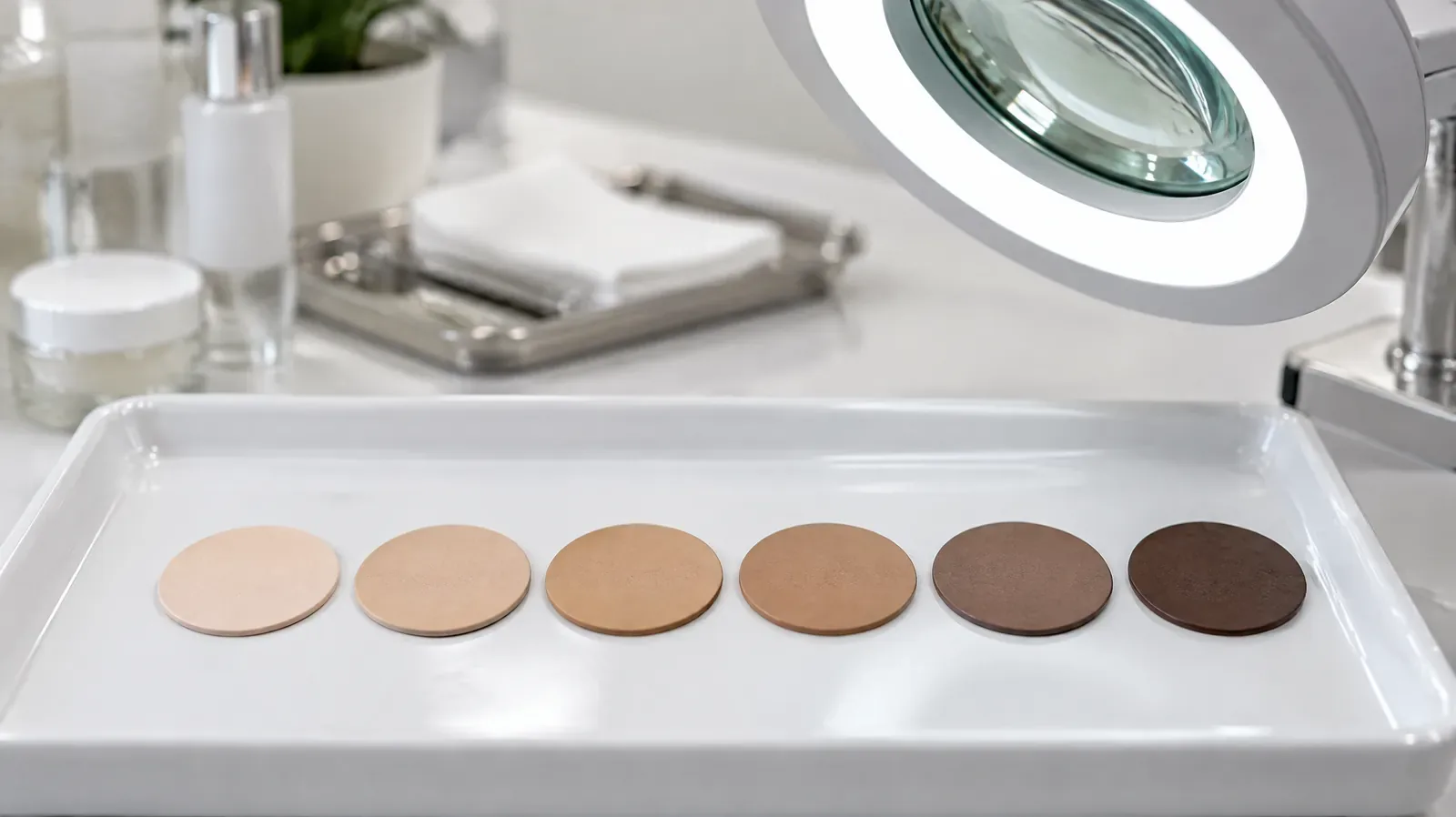
Dermatologists use the Fitzpatrick scale, from type I (always burns, never tans) to type VI (deeply pigmented, rarely burns), to describe how skin responds to light and injury. The more active pigment cells the skin has, the more likely it is to respond to heat and inflammation by making extra pigment. That reaction is called post-inflammatory hyperpigmentation, or PIH: dark patches where the skin was treated.
The numbers are the reason careful practices change their approach:
- A 2025 study in the Journal of Cosmetic Dermatology notes that up to 92% of patients with Fitzpatrick skin type IV and higher develop PIH after ablative CO2 laser treatment.
- A 2026 narrative review in Plastic and Reconstructive Surgery Global Open states that the general recommendation is to avoid ablative lasers for darker skin types because of a significantly higher risk of both hyperpigmentation and hypopigmentation.
- The same review describes the non-ablative fractional 1540-nm erbium laser as both effective and safe for resurfacing in Fitzpatrick types IV to VI.
- An evidence-based review of non-ablative fractional lasers in skin of color reported an overall PIH rate of 0.73% across 961 consecutive treatments in 422 patients with skin types I to V, with PIH more common in patients with skin of color. The authors found that treatment density mattered more than energy: the denser the treatment, the higher the risk.
The ASDS puts it bluntly on its own patient page: people with active acne or very dark skin are usually not good candidates for laser resurfacing. The AAD says lasers can be used on all skin types, but darker skin is more prone to burns and dark marks, and recommends a board-certified dermatologist with experience treating darker skin with lasers.
What a careful plan looks like for each skin type
| Fitzpatrick type | Typical approach | What to watch |
|---|---|---|
| I to II | Ablative or non-ablative depending on goals | Redness that lasts, scarring with aggressive settings |
| III | Often fractional, conservative depth | PIH becomes possible; sun history matters |
| IV | Non-ablative fractional preferred; ablative only with great caution | PIH is the main risk; test spots and pretreatment |
| V to VI | Non-ablative fractional at low density, or non-laser options | Hyper- and hypopigmentation; avoid IPL |
The 2026 review lists the settings principles that lower risk in darker skin: longer wavelength, lower energy, lower density, fewer passes, more time between sessions, and proper cooling after treatment. It also recommends against intense pulsed light (IPL) in types V and VI, and points to radiofrequency microneedling and standard microneedling as alternatives that do not target melanin the way lasers do.
On this site, microneedling and chemical peels cover two of those alternatives, and our erbium laser resurfacing and skin resurfacing pages explain how those treatments are offered.
Preparing for treatment
The AAD’s checklist for laser treatment of scars applies to most resurfacing:
- Quit smoking for at least two weeks before treatment.
- Avoid the sun, tanning beds and sunlamps; you cannot be treated with a tan or sunburn.
- Stop vitamin E, aspirin and other medicines or supplements that can delay healing, if your doctor agrees.
- Stop retinoids and glycolic acid products for two to four weeks beforehand unless your provider has a different plan.
- Take medicine to prevent cold sores if you are prone to them.
For darker skin types the PRS Global Open review adds that pretreatment with topical retinoic acid is recommended to speed healing and reduce the severity and duration of hyperpigmentation. This is one of several places where the right instruction depends on your skin, which is why a provider should give you a written plan rather than a generic handout.
Aftercare, especially in Houston sun
Every source above agrees on one thing: sun protection after treatment is not optional. Fresh skin pigments easily, and Houston UV is strong for most of the year.
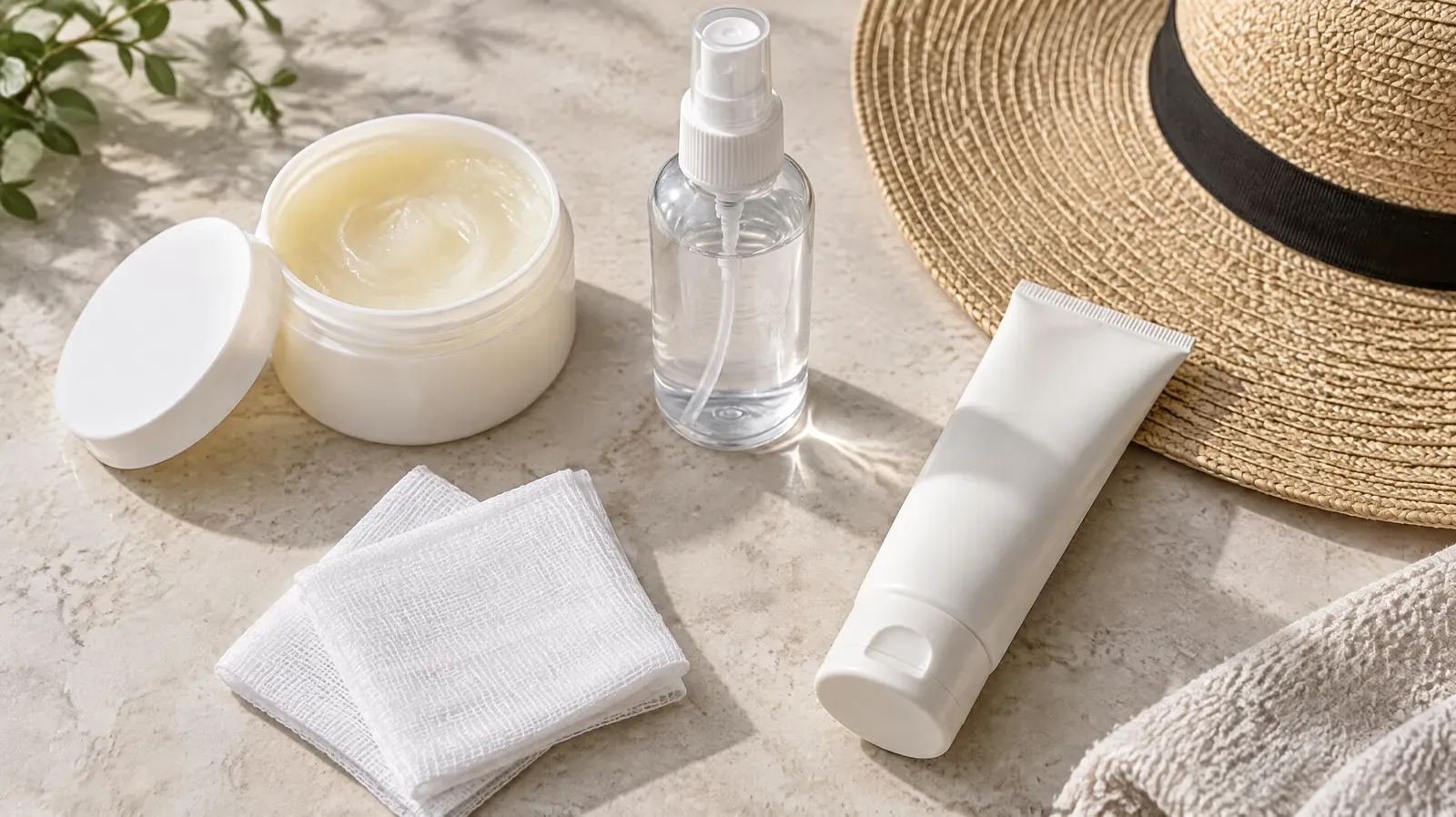
- Follow the wound-care routine exactly during the healing days.
- Use a gentle cleanser and a plain ointment or moisturizer your provider approves.
- Once the skin has closed, use a broad-spectrum mineral sunscreen daily and reapply outdoors.
- Add a wide-brim hat and plan outdoor time for early morning or evening for the first weeks.
- Do not pick at crusts or peeling skin.
- Call the practice if you notice spreading redness, pus, fever or new blistering.
Results: how many sessions, and how long they last
Ablative resurfacing often achieves its main change in one treatment, with collagen remodeling continuing for months. Non-ablative fractional treatments usually come as a series; in the acne-scar studies reviewed in the skin-of-color paper, four sessions at two-week intervals was a common protocol. For scars specifically, the AAD warns that it can take months to see results and you may notice little improvement at first.
No laser stops aging. Sun exposure, smoking and time keep working on the skin afterward, which is why maintenance and daily sunscreen are part of any honest plan.
Myths worth retiring
“One strong session is better than three gentle ones.” For lighter skin and the right goals, one ablative treatment can be the efficient choice. For medium and deep skin tones the evidence points the other way: lower density, fewer passes and more time between sessions are exactly what the reviews above associate with lower pigment risk.
“Darker skin can’t have laser treatment.” The AAD says lasers can be used on all skin types. What changes is the device, the settings and the experience of the person holding the handpiece. The 2026 review describes the 1540-nm non-ablative fractional erbium laser as both effective and safe for Fitzpatrick IV to VI.
“A little tan won’t matter.” It does. The AAD is explicit that you cannot be treated with a tan or sunburn. Reschedule rather than asking for lower settings on tanned skin.
“If it peels, it’s working.” Peeling is part of ablative healing, but it is not a measure of results. Some of the most useful treatments for darker skin cause little visible peeling at all, and their results come from collagen remodeling over months.
Choosing between a laser and the alternatives
| Your situation | Often considered first | Why |
|---|---|---|
| Fine lines, light skin, can take a week off | Ablative erbium or CO2 | Fastest visible change in one session |
| Texture or acne scars, medium to deep skin | Non-ablative fractional series | Lower PIH risk with conservative settings |
| Uneven tone, any skin type, little downtime | Light chemical peel series | Superficial depth, gradual change |
| Scars or firmness, deep skin tone | Microneedling or radiofrequency microneedling | Does not target melanin the way lasers do |
| Significant laxity | Surgical consultation | Resurfacing improves surface and firmness, not heavy sagging |
Questions to ask before you book
- What is my Fitzpatrick type, and how does it change what you recommend?
- Ablative or non-ablative, and why for my goals?
- Will you do a test spot first?
- What density, number of passes and number of sessions do you plan?
- What pretreatment and aftercare do you want me to follow, in writing?
- How many people with my skin tone have you treated with this device?
- What happens if I develop dark patches, and how is that treated?
The bottom line
The best laser is the one matched to your skin, your goals and how much downtime you can actually take. For lighter skin types, ablative lasers can deliver dramatic change in exchange for a hard week. For medium to deep skin tones, the evidence favors non-ablative fractional treatments at conservative settings, or non-laser alternatives, with careful preparation and serious sun protection. Whatever you choose, it should start with an in-person assessment, not a package price.
Sources
- Laser Resurfacing (American Society for Dermatologic Surgery) asds.net
- Laser Skin Resurfacing (American Society of Plastic Surgeons) plasticsurgery.org
- Noninvasive Cosmetic Treatments for Fitzpatrick IV–VI: A Narrative Review of Safety and Efficacy Guidelines (Plastic and Reconstructive Surgery Global Open, 2026) pmc.ncbi.nlm.nih.gov
- A Novel Peel to Prevent Post-Inflammatory Hyperpigmentation After CO2 Resurfacing for Acne Scars (Journal of Cosmetic Dermatology, 2025) pmc.ncbi.nlm.nih.gov
- Nonablative Fractional Laser Resurfacing in Skin of Color: Evidence-based Review (Journal of Clinical and Aesthetic Dermatology, 2017) jcadonline.com
- Skin conditions that lasers can treat (American Academy of Dermatology) aad.org
- 10 things to know before having laser treatment for your scar (American Academy of Dermatology) aad.org
- Many ways to firm sagging skin (American Academy of Dermatology) aad.org