
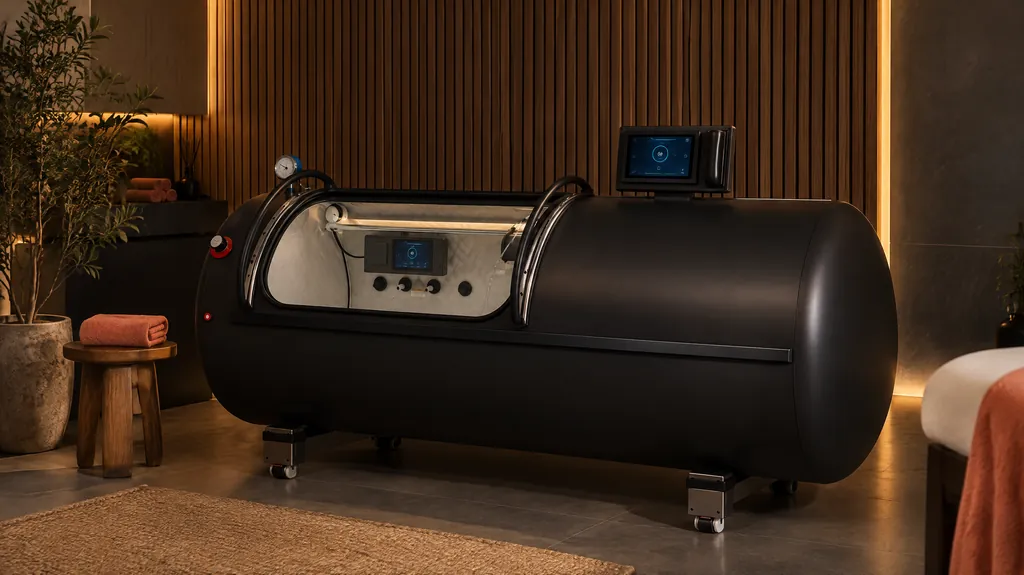
Most of what we write in this journal is for clients. This one is for the people on the other side of the treatment room: owners and medical directors who keep getting asked, by clients and by sales reps, whether a hyperbaric chamber belongs next to the injection suite.
We are not going to tell you that it does. A chamber is a large, slow-moving asset that eats a room, needs a trained person nearby every minute it is pressurized, and earns money only when people are inside it. What we can do is lay out the three equipment tiers a med spa can realistically buy, what each one asks of your floor plan and your staff, and how the numbers behave when you are honest about how many seats you will fill.
One framing point first. Hyperbaric chambers are regulated as medical devices and cleared for specific uses. General wellness, skin quality or “recovery” sit outside those uses. Anything you put on a menu card should be written with that in mind, and run past your medical director. Our medical disclaimer applies to everything below.
The three tiers in one table
| Soft-shell | Hard-shell, single seat | Hard-shell, multi-seat | |
|---|---|---|---|
| Typical pressure | 1.3 to 1.5 ATA | Up to 2.0 ATA (some clinical units higher) | Up to 2.0 ATA |
| People per session | 1 (a few large models hold more) | 1 | 2 to 4 |
| Construction | Fabric, zipper seal | Steel or acrylic vessel | Steel vessel, seated |
| Power | Standard outlet on the models we checked | Varies; confirm circuit | Varies; confirm circuit |
| Room demand | Small; a treatment room corner | A dedicated room | A dedicated room with ceiling height |
| Client feel | Lying in an inflated tube | Lying or reclining in a capsule | Sitting in a small cabin |
| Rough price band | Low four to low five figures | Mid five to six figures | Upper five to six figures |
| Staff attention | One attendant per client session | One attendant per client session | One attendant per run, several clients |
Price bands are deliberately wide. Vendors bundle delivery, install and training very differently, and a quote without those lines is not comparable to one with them.
Tier 1: Soft-shell (mild) chambers
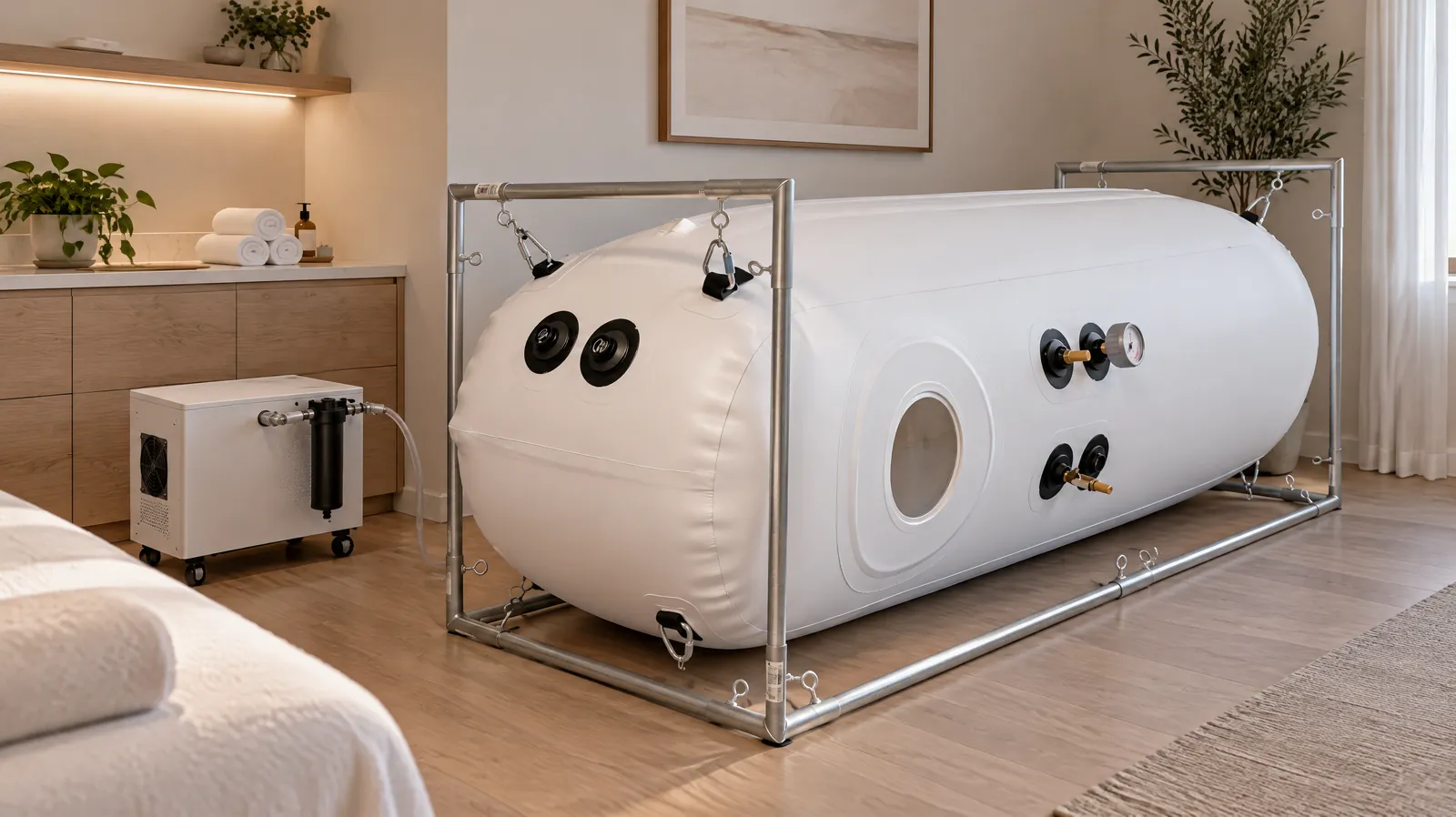
These are the inflatable chambers most people picture. A compressor pressurizes a fabric shell to a modest pressure, and the client breathes concentrated oxygen through a mask or hood. On the makers’ own sites, as of this writing:
- Newtowne Hyperbarics builds its soft chambers in the U.S., describes them as Class II medical devices and publishes its FDA 510(k) number. Its models run at 1.3 ATA, carry a standard two-year warranty, and were listed on sale from $4,095 for the smallest lying model, with monthly rentals from $900. It also sells a “Shoe” chamber that lets the client sit up.
- Summit to Sea states its chambers are FDA cleared and made in the U.S. Its lying models start at $7,995 and run at 4.4 psi (1.3 ATA) on a standard 120V outlet with two compressors for redundancy. The larger Grand Dive, a 40-inch-diameter chamber from $13,995, is described as roomy enough for two to three people, and a vertical version takes a chair.
- OxyHealth sells soft models (the Quamvis 320 and Respiro 270) rated at 1.3 ATA.
- Airvida lists lying and sitting soft-shells in the 1.2 to 1.5 ATA range.
- Superhuman’s soft-shell, the S1, is rated to 1.5 ATA and is listed from $14,900.
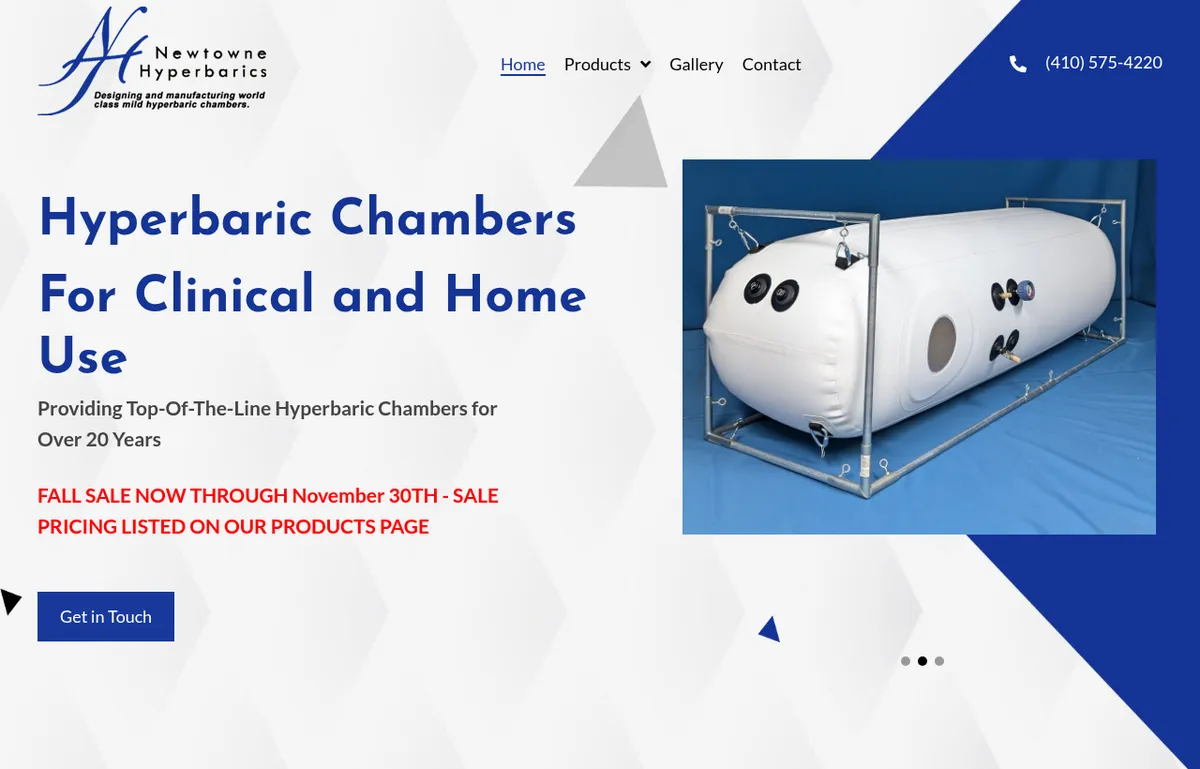
Newtowne Hyperbarics homepage, screenshot taken October 2026.
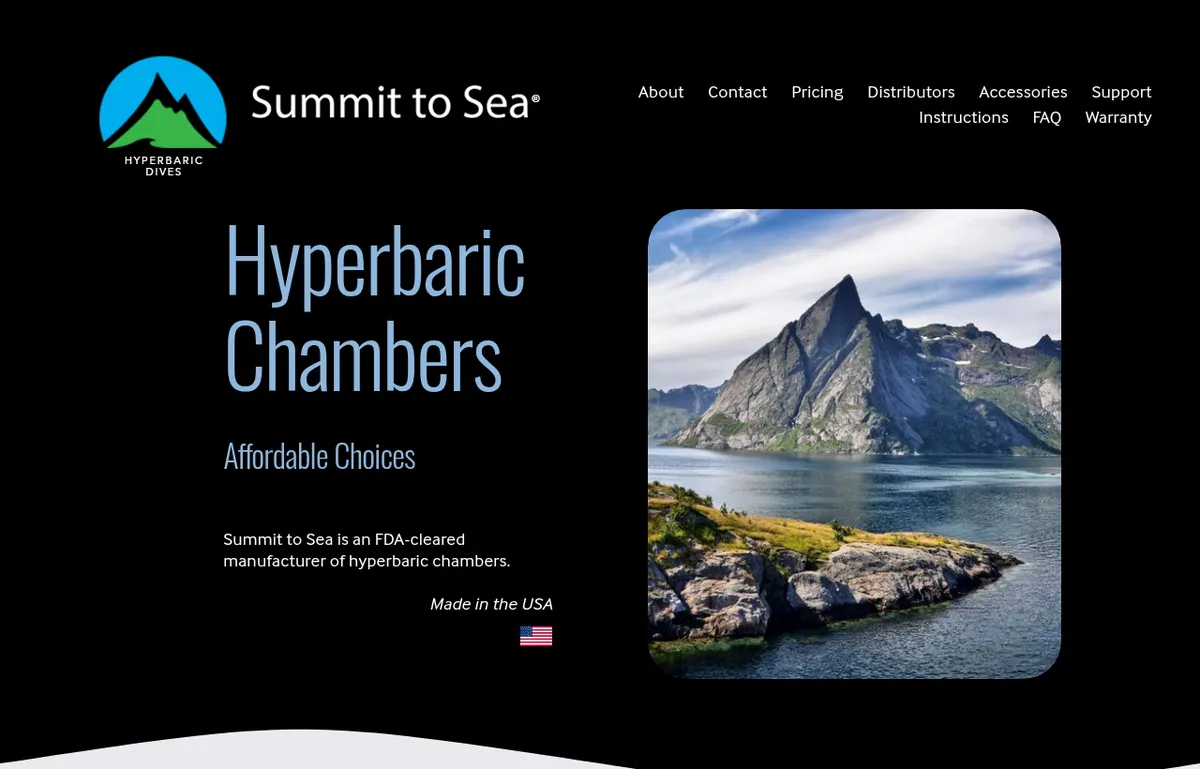
Summit to Sea homepage, screenshot taken October 2026.
Pros
- Lowest buy-in, and the only tier where renting before buying is common.
- Fits an existing treatment room without construction; standard power.
- Easy to move if the experiment does not work.
Cons
- The ceiling on pressure is low, which limits what you can honestly offer and how you can describe it.
- It looks and feels like a consumer product. Clients paying med spa prices notice.
- Zippers, seams and fabric wear. Expect a shorter service life than a steel vessel, and ask about replacement shell cost.
- One person per session on most models, so revenue per staff hour is the lowest of the three.
Tier 2: Hard-shell single-seat chambers
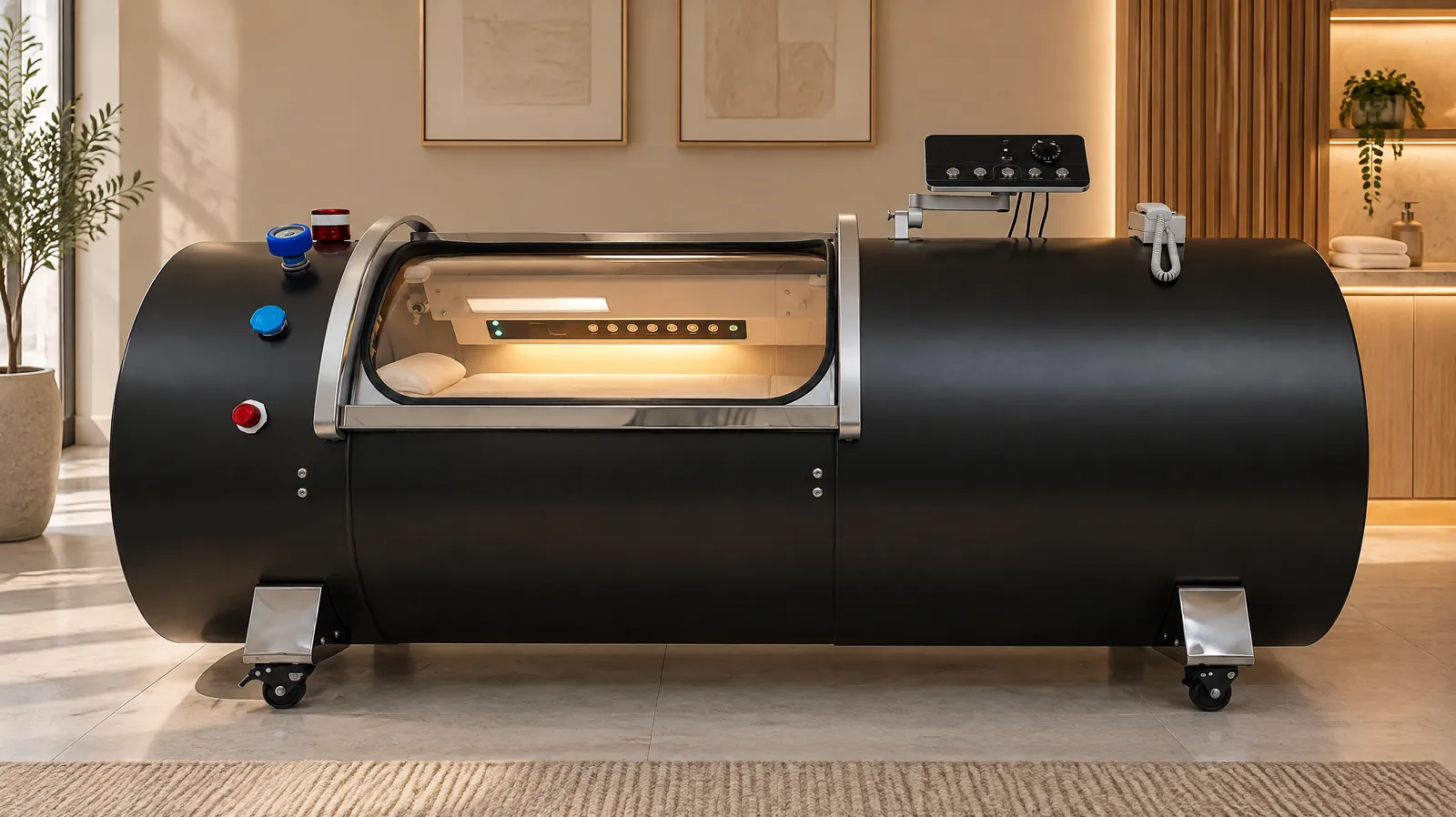
A rigid pressure vessel that one client lies or reclines in, usually reaching 2.0 ATA. This is where the engineering standard starts to matter. ASME’s PVHO-1 is the safety standard for pressure vessels that hold a person, covering design, fabrication, inspection and testing, and it applies to hyperbaric chambers once the pressure differential exceeds 2 psi. Ask every vendor exactly how their vessel relates to PVHO-1: designed to it, tested to it, or built in a certified shop. Those are three different claims.
On the market: OxyHealth’s Fortius 420, sold under the CHAMBERS by Fortius name, is a hard-shell clinical chamber that the company lists at 1.3 to 4.0 ATA with FDA 510(k) clearance. OxyHealth also sells the Vitaeris 320 hard-shell at 1.3 ATA. Airvida lists lying and seated hard-shells at 1.3 to 2.0 ATA. Superhuman offers two single-seat hard-shells, the L1 (lying, from $49,900) and the seated X (from $79,900), both rated to 2.0 ATA, and states that installation and on-site training are included in the price.
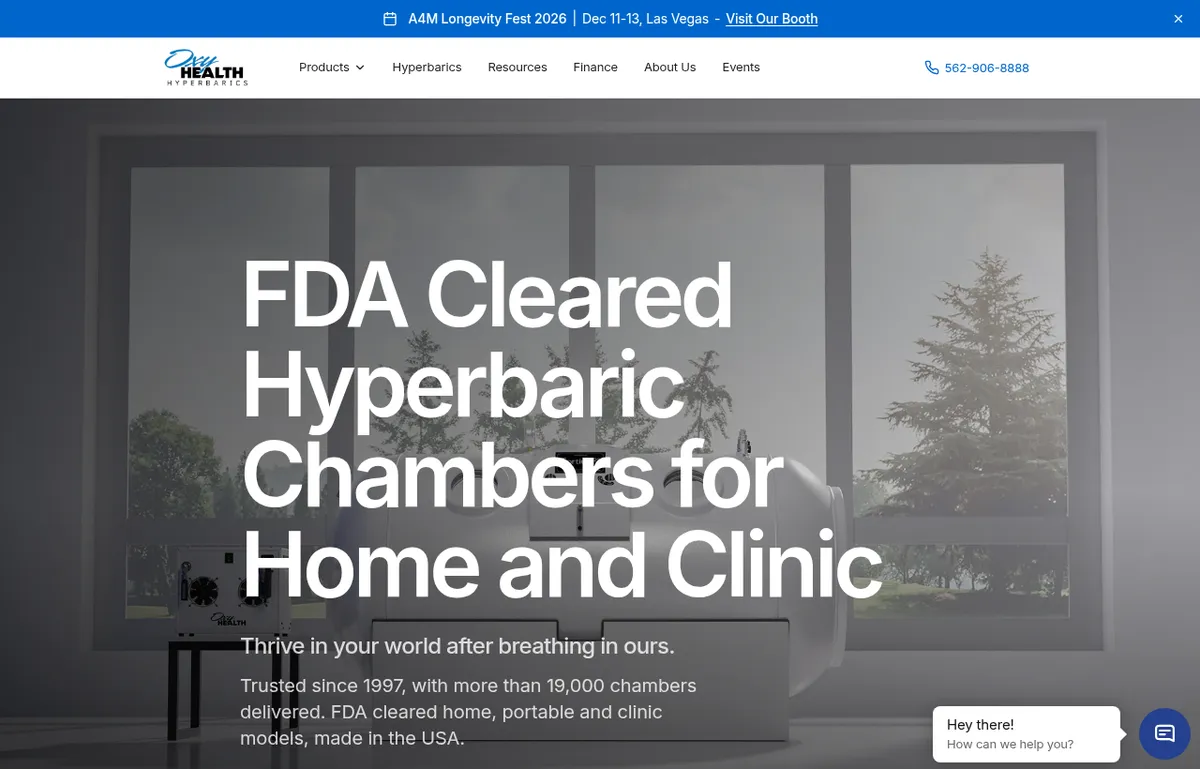
OxyHealth homepage, screenshot taken October 2026.
At the hospital end sit Perry Baromedical, whose Sigma monoplace chambers (Sigma 34, 36 and 40) are built for physician-run programs and come with facility design help on purchase, and Sechrist Industries, whose H-Series monoplace chambers are aimed at hospital and wound care units. Neither publishes prices, and both are priced for hospitals.
Pros
- Higher pressure range and a more serious, clinical presentation.
- Steel or acrylic vessels are built for many years of daily use.
- Air-pressurized chambers that deliver oxygen by mask keep pure oxygen out of the chamber atmosphere, which matters for fire risk (more on that below).
Cons
- Still one client per session, at three to ten times the soft-shell price.
- Needs its own room. A capsule in a shared space kills the experience.
- Freight, door widths and floor loading become real questions.
- Some clients find a lying capsule claustrophobic; Cleveland Clinic lists claustrophobia as a known issue with single-person chambers.
Tier 3: Hard-shell multi-seat chambers
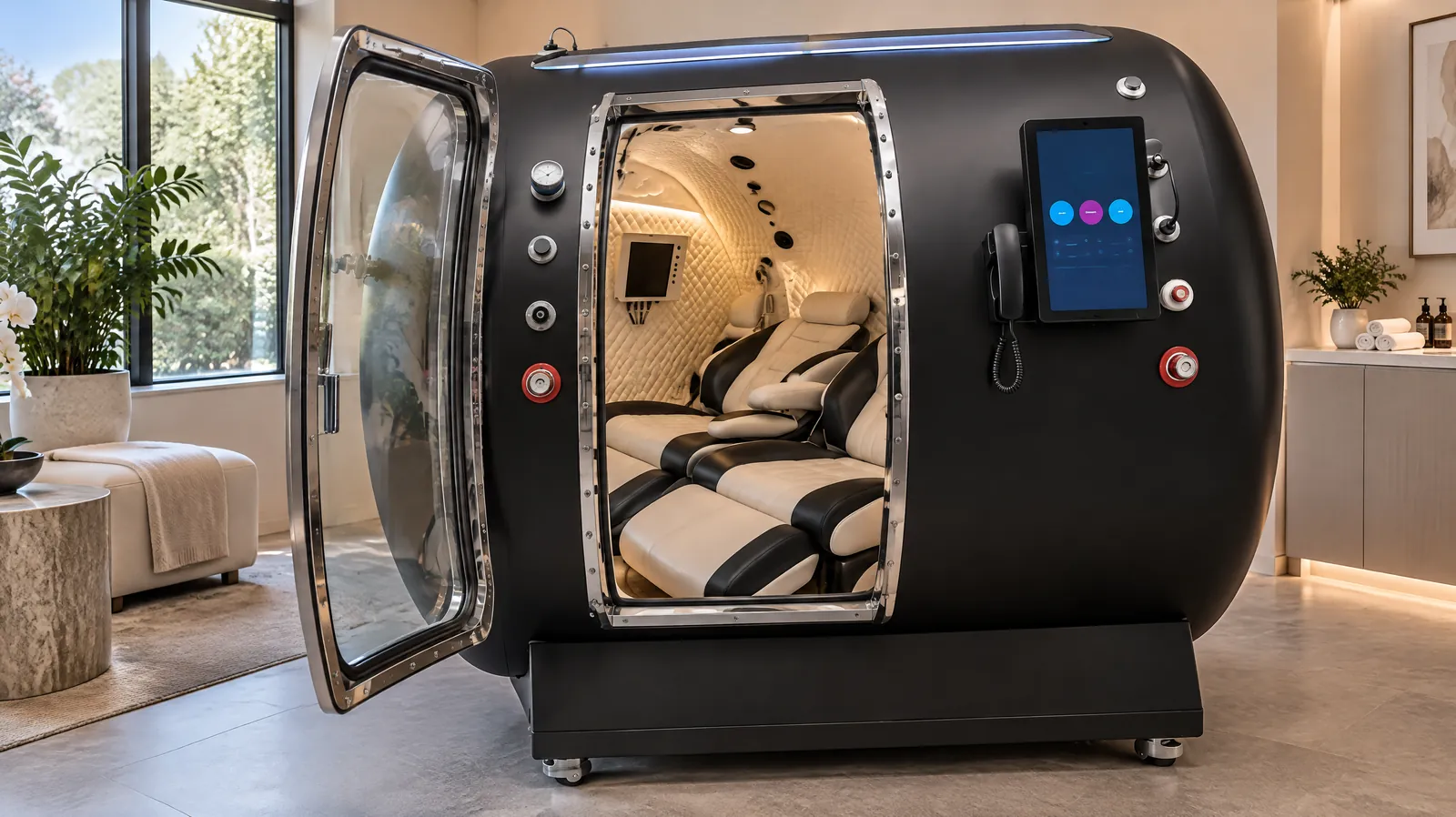
Seated, walk-in vessels for two to four people. Hospital walk-in rooms are a different category altogether; Perry, for example, lists a dualplace Sigma 40-II and a multiplace series for 2 to 18 people, sized and priced for hospitals. What a med spa can realistically fit are compact units. Summit to Sea’s larger soft units technically hold more than one person, but in the hard-shell space the options are fewer. Superhuman’s T2 seats two (footprint about 6 ft 10 in by 5 ft 5 in, roughly a 6 ft ceiling, from $99,900) and the T4 seats four (about 7 ft 7 in by 5 ft 5 in, from $169,000 all-inclusive). Both are rated to 2.0 ATA. Ask any other maker for current commercial models rather than brochures.
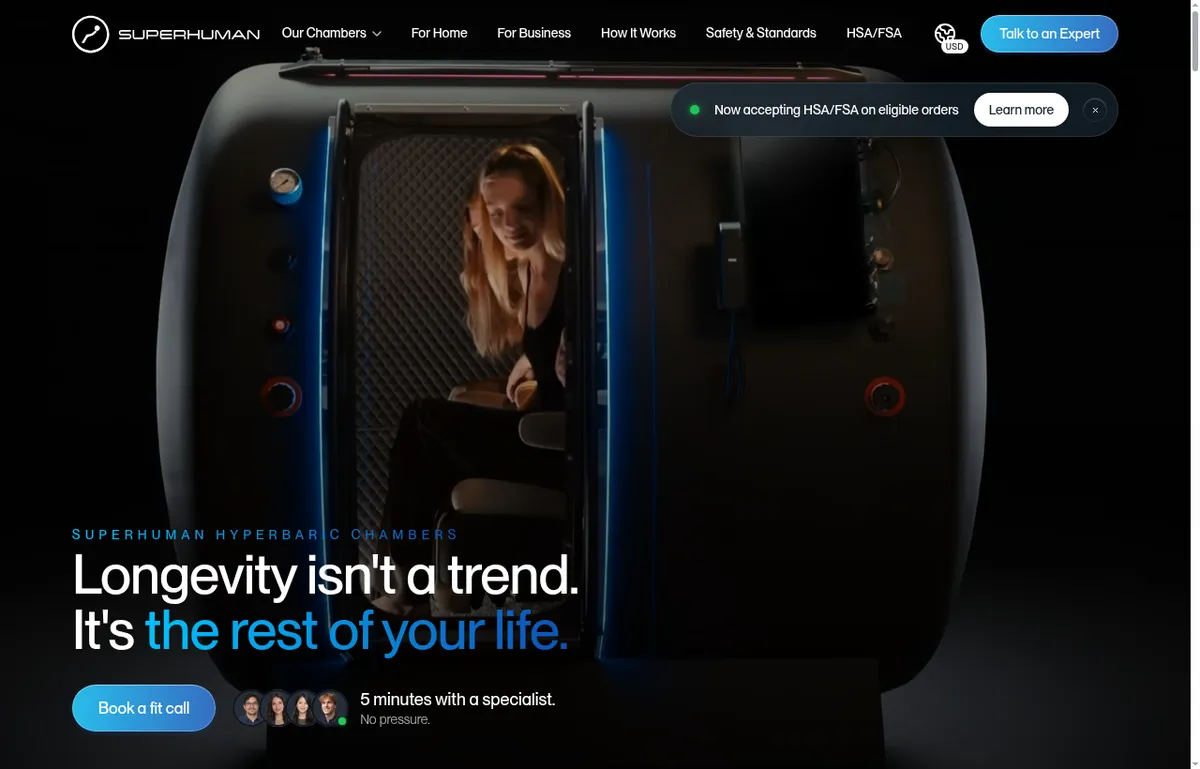
Superhuman homepage, screenshot taken October 2026.
Pros
- Revenue per operator hour is the highest of the three, because one trained staff member supervises several seats at once.
- Seated sessions read as social and calm rather than clinical. Couples and friends book together.
- Seats can be sold individually or as private sessions.
Cons
- Highest capital outlay, and the payback depends entirely on filling seats.
- A four-seat run with one booked client earns single-seat revenue on a multi-seat asset.
- Scheduling becomes the job. Sessions run on fixed start times, so late arrivals affect everyone.
- Ceiling height and delivery route need checking before you sign.
Staffing, consent and safety: the same rules at every tier
This part does not get cheaper with a cheaper chamber.
Someone trained is present for every session. The FDA’s August 2025 letter to health care providers asks facilities to follow each device’s instructions for use, train staff on operation, keep patients continuously monitored, keep prohibited items (electronics, static-producing materials) out of the chamber, and use hyperbaric-compatible clothing. The same letter notes a heightened risk of fire when oxygen is used at high concentration, and reports of fires that caused serious injuries and deaths.
Fire code is a facilities question, not a vendor question. NFPA 99, the Health Care Facilities Code, has a chapter dedicated to hyperbaric facilities. Have your fire marshal and your building owner look at the specific unit before it arrives, not after.
Screening and consent are written by your medical director. Cleveland Clinic lists collapsed lung or lung disease that raises that risk, a recent cold or fever, and recent ear injury or surgery among reasons not to have a session. Its listed side effects include ear injury and, rarely, oxygen toxicity or seizures. Your intake form should screen for these, record the answers, and make clear the session is not a treatment for any disease unless your practice is actually set up to deliver one. The Undersea and Hyperbaric Medical Society is the reference body for clinical practice and facility accreditation if you want to understand what a medical hyperbaric program looks like.
Device status matters for marketing. Many chambers are Class II devices cleared through the FDA’s 510(k) pathway for specific uses. Clearance of a device is not a licence to advertise it for other things.
“Registered” is not “cleared.” Some listings say a chamber is “FDA registered.” Registration and listing is how the FDA records which establishments make devices and where; a device that needs marketing authorization must also carry a premarket submission number, such as a 510(k). Ask for that number and look it up yourself.
Your insurer will ask. Tell your liability carrier before the chamber is delivered, not after. Expect questions about the device’s clearance, its pressure rating, who supervises sessions and what your intake form covers.
Pricing the service
Three structures cover most chamber menus:
- Single sessions at full price. Useful for first visits; few clients stay on this.
- Packs of sessions (five or ten), prepaid at a discount. This is where most of the volume tends to sit, and it smooths your schedule.
- Memberships with a set number of sessions per month. Best for predictability, but a member who books every allowed slot lowers your average price per session.
In the model below, use the average you actually collect, not the menu price.
A worked revenue model (hypothetical)
Every number in this section is an assumption we chose for illustration. It is not a projection, a quote, or data from any clinic. Swap in your own prices, hours and staffing before you use it for anything.
Assumptions:
- Open 9 hours a day, 25 days a month.
- 60-minute sessions plus 15 minutes turnover: 7 session slots per day per seat.
- Average collected price per seat-session: $80 soft-shell, $135 single hard-shell, $115 per seat in the four-seat chamber.
- An attendant at $24/hour, paid for the time a run is in progress. Four-seat runs average two clients.
- $3 per run for power, filters and linens; $450/month for extra insurance and booking software.
- Equipment prices: $15,000 soft-shell, $50,000 single hard-shell, $169,000 four-seat. Rent, financing, depreciation, marketing and tax are left out.
Scenario A: 40% of seats filled (25% for the four-seat chamber)
| Soft-shell | Single hard-shell | Four-seat | |
|---|---|---|---|
| Seat-sessions per month | 70 | 70 | 175 |
| Gross revenue | $5,600 | $9,450 | $20,125 |
| Attendant cost | $2,100 | $2,100 | $2,625 |
| Consumables + overhead | $660 | $660 | $712 |
| Monthly contribution | $2,840 | $6,690 | $16,788 |
| Months to cover equipment | ~5 | ~8 | ~10 |
Scenario B: half that (20%, and 12% for the four-seat chamber)
| Soft-shell | Single hard-shell | Four-seat | |
|---|---|---|---|
| Seat-sessions per month | 35 | 35 | 84 |
| Monthly contribution | ~$1,200 | ~$3,120 | ~$7,820 |
| Months to cover equipment | ~13 | ~16 | ~22 |
Break-even, the number to give your front desk. Divide your monthly fixed costs by what each session contributes after its own labor and consumables. If you want the chamber paid off in 24 months, add one twenty-fourth of its price to the fixed costs. On the assumptions above, that works out to roughly 23 seat-sessions a month for the soft-shell, 25 for the single hard-shell and 76 for the four-seat chamber. That is about one booked seat a day for the single-seat options and three a day for the four-seat.
Utilization moves the answer more than the equipment does, and the multi-seat chamber is the most sensitive to how well you fill runs: the numbers look strong only if clients book in pairs or groups. If your clientele books alone, at odd hours, a single-seat unit may earn more per square foot.
There is also an opportunity cost the table ignores. The room you give the chamber could hold another injector or a laser. If that room already earns, the chamber has to beat it, not zero. For a longer look at the operator side, we found this breakdown of chamber business economics useful as a starting point, though it is written by a manufacturer and should be read as such.
Testing demand before you commit
If you are unsure, sequence the decision rather than making it in one go. Rent or buy a soft-shell first, offer it to existing clients only, and price it at what you would charge long term instead of a launch discount; a cheap trial tells you who likes a bargain, not who will pay. After three months you will know your real fill rate, which slots people want, and whether clients come in pairs. That is exactly the data the hard-shell decision depends on. Some soft chamber makers, Newtowne among them, rent by the month. With hard-shell vendors, ask about trade-in terms before you sign.
Questions to ask any vendor
Bring this list to every call. A good vendor answers in writing.
- What is the maximum pressure, and is it adjustable per session?
- How does the vessel relate to ASME PVHO-1: designed, tested, or built in a certified facility? Can I see the documentation?
- What is the device’s FDA status, what is the 510(k) number, and what exact uses is it cleared for?
- Is the chamber pressurized with air and oxygen delivered by mask, or is the chamber filled with oxygen?
- What does the quote include: freight, installation, commissioning, staff training? What is extra?
- What are the room requirements: footprint, ceiling height, door width, floor load, electrical circuit, ventilation?
- What are the running costs per session and per year, including filters, seals and service visits?
- What is the warranty on the shell, the compressor and the controls, and who does the service in Houston?
- Can the occupant stop the session and release pressure from inside? How is the operator alerted?
- What training and documentation do you provide for our intake, emergency and cleaning procedures?
- Can I speak to two commercial customers who have run the unit for more than a year?
- What is the resale or trade-in policy if it does not work for us?
FAQ
Does a med spa need a physician to offer chamber sessions? That depends on your state and on the device. Some makers state that their chambers are prescription devices that can only be sold to, or on the order of, a licensed practitioner; OxyHealth says this of its whole range. Your medical director and a healthcare attorney familiar with Texas rules should sign off before launch.
Is 1.3 ATA enough, or do we need 2.0? That is a clinical question for your medical director. Operationally, the higher-pressure tier costs more, needs more room and draws more scrutiny.
Can we rent before buying? For soft-shells, often yes. Newtowne, for example, lists monthly rentals. Hard-shell rentals are rare; ask about trade-in and buy-back terms instead.
How long is a session? Cleveland Clinic describes hyperbaric sessions as usually lasting one to two hours. The model above assumes an hour, plus time to pressurize, depressurize and reset the chamber.
Will clients book it alongside aesthetic treatments? Some will, especially as part of a membership. Keep the wording honest: it is a wellness service, not a recovery treatment for a filler or laser appointment, unless your medical director has a documented reason to say otherwise.
Our view
If you want to test client demand cheaply, a soft-shell tells you something within a few months, at the cost of a lower-end feel. If you already have a membership base that books in pairs, a seated multi-seat unit is the one where the economics can work at med spa prices. The single-seat hard-shell sits in between and suits practices with a quiet room to spare and a clientele that prefers privacy. Whichever you choose, start with the room, the fire code and the consent form. The chamber is the easy part.
Sources
- Follow Instructions for Safe Use of Hyperbaric Oxygen Therapy Devices: Letter to Health Care Providers (U.S. FDA, 2025) fda.gov
- Premarket Notification 510(k) (U.S. FDA) fda.gov
- Device Registration and Listing (U.S. FDA) fda.gov
- Safety Standard for Pressure Vessels for Human Occupancy, PVHO-1 (ASME) asme.org
- NFPA 99: Health Care Facilities Code (NFPA) nfpa.org
- Undersea and Hyperbaric Medical Society uhms.org
- Hyperbaric Oxygen Therapy (Cleveland Clinic) my.clevelandclinic.org